Tel Aviv
“You had one job.” We’ve heard this lamentation before; in this case, it was to be at the airport, hold up a ‘Globus’ sign, and get the people to the Hotel Leonardo Tower in Tel Aviv. Okay, okay. Maybe that’s three jobs. Whatever. It still shouldn’t be taken lightly, as the people you are gathering are travel-weary to the extreme. Even after we managed to make all our connections and to arrive on time, we were still beat. And the one thing that we anticipated would be done without problems didn’t go well at all. When we didn’t find our representative after exhaustive searches, we asked Information Desk people to make calls, and eventually – it took quite a while – found people who would provide the needed transportation. This was not before the Lady Adventurer took it upon herself to hold up her own home-made Globus sign and gather a bunch of people who were as mixed up as we were.
It got worse as we arrived at the hotel too late for the meeting; a meeting we would have been on time for had the transportation been as expected. Now we did get to dinner; we nearly never miss meals. But we and many others were still in the dark as to what was up with our trip. When do we wake up, put our bags out, etc.
Things were better, as they always are, in the morning. We got moving but didn’t see much of Tel Aviv at all.
Israel became a country 71 years ago. Before that, it had been a sparsely populated backwater with only a little history. Okay, maybe more than a little. But it’s truly amazing that this country of nine million has not only survived but even thrived amid hostile neighbors and former residents. The desert blooms here, more than anywhere else. Yet the issues, challenges, and controversies continue to this day. History doesn’t stop with yesterday.
 |
| Our Itin |
To and Around Haifa
Along the way from Tel Aviv to Haifa, we stopped to see Jaffa, an ancient port city, Latrun, home of a Trappist Monk Monastery, Cana, a small village that’s home to Jesus’ first miracle – that of changing water into wine, Caesarea, an entire city now in ruins built by King Herod to honor his Roman masters, and Nazareth, Jesus’ original home town. Nazareth was cool at night; it gets dark early here this time of year.
When our guide told us that the monastery monks are allowed to speak only when absolutely necessary, I was reminded of the story of a similar monastery where the monks were only permitted to speak two words every ten years. One new monk, after his first ten years of hard monk-like labor, said, “Hard work.” Ten more years go by, and he says, “I’m tired.” Finally, after yet another decade, he says, “I quit.” The head monk says, “It doesn’t surprise me. You’ve done nothing but complain for thirty years.”
Caesarea was as impressive as any historic city-in-ruins. Would that we could have spent more time there as much as anywhere.
 |
| Caesarea |
 |
| Caesarea |
After a night of some much-needed rest, we ventured out for more the next day. This time we hit the River Jordan, Mount of the Beatitudes, home of Sermon on the Mount and Church of the Annunciation, Capernaum, Jesus’ later home, and the Sea of Galilee for a short cruise. The baptisms and the cruise were highlights. As was lunch: fish caught (okay, farmed) in Sea of Galilee.
I was impressed by the eight statements that comprise the Sermon on the Mount. Just for fun, here they are:
Blessed are...
Blessed are the poor in spirit, for theirs is the kingdom of heaven.
Blessed are those who mourn, for they shall be comforted.
Blessed are the meek, for they shall inherit the earth.
Blessed are those who hunger and thirst for righteousness, for they shall be satisfied.
Blessed are the merciful, for they shall obtain mercy.
Blessed are the pure in heart, for they shall see God.
Blessed are the peacemakers, for they shall be called sons of God.
Blessed are those who are persecuted for righteousness’ sake, for theirs is the kingdom of heaven.
Our guide stressed that although these ideas seem self-evident to us now, they were quite revolutionary in Jesus’ time.
Mount of the Beatitudes and nearby Capernaum, both sculptured with gardens, are almost heavenly as they overlook the Sea of Galilee, doubtless more so now than two millennia ago.
 |
| Sea of Galilee from Mount of Beatitudes |
It occurs to me that these group tours are so much checklists. You know: I saw and did a, b, and c. Well, this one is that in spades. The thing is, Israel has so many things to see that to see them, you absolutely do need such a list. Now it would be nice to spend more time exploring these fantastic historical/religious places, but when you ain’t got the time, this way is the best.
It’s also fun to see all the other people doing the same thing we are. Yes, there are tour buses galore. It’s early December now; things must be tons worse in the summer. But still, we see some of the same other people on occasion, like the religious people from Nigeria who were baptized in the River Jordan, then partied heartily in their boat, which was next to ours on the Sea of Galilee cruise.
Whilst on that cruise, and after visiting the other sites, our tour director had us hold our hands out from our sides. He then told us that seventy percent of the New Testament took place between our arms.
 |
| Sea of Galilee Cruise |
Capernaum was not only Jesus’ home but also St. Peter’s birthplace. An ancient dug-out home that may have been Peter’s was over-built by a Byzantine Church and is currently under a modern museum. Visitors can view it through the glass from above. When I dropped my lens cap on the glass, it rolled away, and I couldn’t reach it through the barrier fence. Lady Adventurer to the rescue – she used her Vox/Whisper listening device and it’s neck strap to fish it back to us. A miracle, if there ever was one.
Haifa is also home to the Baha’i Shrine, the world center of the Baha’i faith. The Baha’i broke away from Islam 200 years ago to form a new and unique religion. The garden was extensive; we walked around the beautiful central terrace, and this was only one of nineteen such levels. Lady Adventurer went inside the temple itself.
 |
| Looking at Haifa from the Baha’i Shrine |
 |
| Baha’i Shrine included 19 levels of gardens |
Around Jerusalem
We traveled through the Valley of Elah, where David slew Goliath and won the battle against the Philistines. The words Palestine and Philistine are derived from the same source. The Romans had trouble with the pronunciation as they were in the process of kicking the Jews out, and the name Palestine became more common for the area. When Jews moved back to Israel, the people living there at the time became known as Palestinians.
We spent nearly an entire day around Bethlehem. Under the Church of the Nativity, one of the oldest churches in the world, we saw Jesus’ assumed birthplace and manger. What with the pushing and shoving to the extreme, it was quite an ordeal to get inside; these people need Disney to get them organized.
The Israel Museum had a scale model of the Old City of Jerusalem. The highlight, however, was the Dead Sea Scrolls; several were out on display, and we learned more about how they were discovered and how they relate to current religious beliefs.
The Holocaust Museum was as expected. I just kept thinking of how our current government appears to be headed down the same path as that of Nazi Germany. The stories of the survivors were harrowing and deeply touching.
You know what happened when Napoleon went to Mount Olive, don’t you? Popeye got mad. The Mount of Olives was super cold and windy, but it afforded a great view of the Old City. From there we walked down (it was steep) to the Garden of Gethsemane, where Jesus spent his last evening before being arrested.
 |
| The Old City from the Mount of Olives |
The Garden Tomb is located outside the Old City, but it’s a nice garden area on a nearby hill. It’s one possible location of Jesus’ tomb from which he late rose. We later saw the other one, located within the Church of the Holy Sepulchre. That church, by the way, along with the surrounding area including Stations of the Cross, were magnificent, crowds be damned. Okay, since they’re there, maybe they won’t be. Another thing about the church: it’s about eight churches in one, all of different faiths. But this entire long day spent in the Old City ending with the Western Wall was certainly a highlight.
 |
| Western Wall |
The Jerusalem Sight and Sound Spectacular far exceeded expectations. Having attended one that was not as great in Egypt, I was unprepared for how stunning this show would be. Images were projected on ancient buildings including and around the Tower of David inside the Old City. They told, without words, the historical story of Jerusalem. It was nearly indescribable.
 |
| Jerusalem Sight and Sound Spectacular |
 |
| Jerusalem Sight and Sound Spectacular |
 |
| Jerusalem Sight and Sound Spectacular |
The desert begins immediately upon driving south out of Jerusalem. Although there are some Bedouin and Israeli settlements, the desert is desolate. Before long, we were in the lowest place on earth, the Dead Sea. It rains four or five days a year in this desert. It did for us this day, but it didn’t last too long.
 |
| Masada |
We saw Masada, a stunning location, Qumran, where we lunched amongst a billion people in the location where the Dead Sea Scrolls were found, and then I went down to swim in the Dead Sea itself.
 |
| Masada |
First, you go down some stairs, lots of stairs. You go way, way down. It seems the water level is constantly getting lower. Then you walk through thick, yucky mud. You can rub said mud all over your body, but I decline. Then you climb over rocks and sharp stones, backing yourself into the water. There’s nothing but slippery mud and more sharp rocks under your feet, but you just have to keep going into that water. They’d told us not to shave, and to be careful of any cuts. They’d also told us not to try to swim; to keep the water off our faces, especially our eyes. They’d told us to just lay on our backs and float. This is a difficult concept for someone who’s never been able to float in his life. Then you relax and enjoy. But don’t let yourself float too far away – you won’t be able to get back since you can’t swim. Then you try to get yourself back out. This is the most difficult part of all. Then you shower and change in the public changing room. This is tough as well. I’m still feeling that strange sensation on my skin. I decide that although the experience was unique, I do not need to repeat it anytime soon. Or even not so soon.
 |
| Dead Sea |
At our first of two farewell dinners, we said goodbye to our Israel tour guide, Yuval Kalev, and some of the other travelers who were not going on to Jordan. ‘Val’ did a wonderful job of relating the history, tradition, and religious significance of what we’d seen. And we saw a lot. Now, on to Jordan!
To and Around Amman
Crossing the border from Israel to Jordan took hours and was quite the ordeal. We met our new guide, Ali Moses, and continued through Amman to Jerash.
Although the Ancient City of Jerash had been inhabited for thousands of years earlier, it flourished in the Greco and Roman periods. Today it is one of the best-preserved Greco-Roman cities, rivaling Pompeii and Ephesus. Having experienced the latter a couple times, I can say that Jerash is every bit as impressive in size, scale, and splendor.
 |
| Jerash |
Amman itself would be fascinating. That is, if we could see it without snarled traffic, pouring rain, and only one dark night.
To and Around Petra
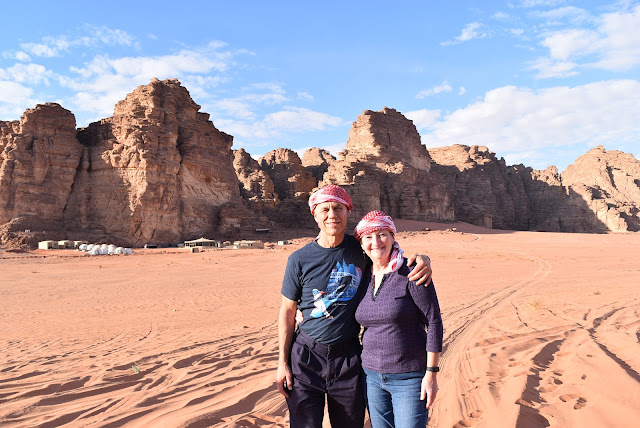
On the way to Petra, we detoured to Wadi Rum. This is the place where Lawrence of Arabia, the Martian, one of the Star Wars flicks, and several other movies were filmed. It’s about as desolate as you can get, yet rock formations spring up from the desert floor to form fantastical arrangements. The entire afternoon and evening were devoted to this area. We got around on the back of 4wd vehicles, and it was loads of fun. We joked that riding in the back of pickup trucks wearing our Arabian headscarves, we looked like a bunch of terrorists. Luckily, there weren't any drones on nearby patrol. The sunset and moonrise were spectacular.
 |
| Wadi Rum |
 |
| Wadi Rum |
 |
| Wadi Rum |
Nothing can prepare you for Petra itself. Okay, okay. Seeing it in the Indiana Jones movie can help. And maybe a Nova episode or two. But, built mostly in the fourth century B.C. by the Nabataeans, it’s truly huge in scale, and the famous Treasury Facade is only one of many. We walked through the Siq – the narrow canyon not unlike something you’d find in Zion NP - leading up to the Treasury, the Street of Facades, the Nymphaeum, the Theater, the Colonnaded Street, etc. Albeit far, it was a pretty easy downhill walk the entire way. It would have been difficult to turn around to go back up, so of course, we went further: this time up the Ad Deir (Monastery) trail. This one was up – way up. 800+ stairs up. Over 1,000 vertical feet of bad footing up.
 |
| Petra Treasury |
By the way: whilst at the site, we learnt that Petra means ‘Rock’ in some ancient language. Seems appropriate, no?
That monastery was worth the trouble. Its facade was not unlike that of the Treasury, but it was even larger and more grand. Now we had an hour and fifty minutes left to go back down – steeply down - then back up – way up - to the entrance. We made it: 8.4 miles and over 2,000 feet of total elevation change. Wow.
 |
| Petra Monastery |
We also took an excursion to Little Petra. It was like Petra, but smaller. It was pretty neat, with more caves to explore and less walking and climbing. The best part of this was the sunset; it was spectacularly red.
 |
| Little Petra Sunset |
To and Around the Dead Sea
Karak Castle was built by the crusaders during the twelfth century. It was constructed on top of an older structure from centuries earlier. Why castle upon castle at this place? That’s easy: location, location, location. There are steep cliffs on three sides. This is the largest crusader castle, and it’s wonderfully preserved. It’s interesting how the crusaders are viewed in this part of the world: they were terrorists, like ISIS is today.
 |
| Karak Castle |
We drove through Wadi Mujib, the “Jordanian Grand Canyon.” A new dam was built here fifteen years ago.
During a stop in Madaba, we had Maqluba for lunch. It’s a traditional Jordanian dish that’s cooked with chicken, rice, vegetables, and plenty of spices, and turned upside down for serving. We then toured several ancient Christian churches in the village. The mosaics included the famous ‘Tree of Life.’
Our resort on the Dead Sea was something. Having already had the experience, I did not partake in the mud or saltwater activity this time. On our final day, we drove to Mt. Nebo, the place where Moses died, witnessed the creation of mosaics (but declined to buy any), and looked out over the very narrow River Jordan, as we’d done on the Israel side. It seems there are many baptismal sites along the way.
 |
| Mt Nebo |
Alas, time to say goodbye to our traveling companions. Israel had been hectic, crowded, and confusing. Jordan was much better in those ways, but it was good to experience both.
 |
| River Jordan |


